
Douglas County Busted Mugshot Records
Every booking at the Douglas County Correctional Facility begins the same way. Someone enters after an arrest, a surrender, a remand, or a warrant. Lawrence Police, Eudora Police, Baldwin City Police, and the Douglas County Kansas Sheriff's Office can all make that arrest. Once a person enters the county system, though, the sheriff's report treats them the same. The entry gets an identifying number, demographics, the arresting agency, charge text, bond data, housing details, and a booking photograph. Treat these reports as shifting snapshots rather than fixed profiles, since details change as custody moves along.
A busted Douglas County mugshot is one step in a longer paper trail. The arresting agency writes the first charge wording. Jail staff log the admission. Later, a prosecutor files what will actually move forward, and the court records amendments, dismissals, pleas, sentences, or expungements. The booking photo shows only that an image was taken during intake, and jail charge wording can differ from the eventual complaint. The court disposition, meaning the final recorded outcome, is the document worth relying on.
DCCF holds people for many reasons, and that matters when you read a roster row. One person may be waiting on a first court appearance. Another may be serving a local sentence, held on a warrant, or kept for another authority. So a housing line and a charge label need context first. The roster covers current county responsibility, not every arrest ever made here. Booking Recap shows whether DCCF logged an admission in the past 14 days. Someone can stay in custody after dropping off the recap, or linger on it after release.
Douglas County Booking Record Fields
Douglas County labels its reports differently across Booking Recap, In Custody, and Bond Amounts. Always check the spelling and identifier against the court file before trusting a match. The generation time matters too. The normal refresh cycle runs four hours. An outage can leave a stale view on your screen.
| Field | What it means |
|---|---|
| Name and identifying details | Name, birth date or age, sex, race, ethnicity, hair, eyes, and height help distinguish people with similar names. |
| CHRI, inmate, or person number | The local identifier changes label by report. The CHRI number is needed for a photo request. |
| Booking and release time | Admission and release events, not the incident time or a conviction date. |
| Arresting agency and case | The agency, arrest number, location, officer, and agency case number tied to intake. |
| Charge and judicial status | Statute, description, count, disposition code, court, and case number as recorded at that moment. |
| Bond | Type, amount, and number. A judge can change these terms. |
| Housing or location | Current placement, including a facility outside Douglas County for someone still under county custody. |
| Booking photograph | Not displayed in the ordinary reports. Ask the public information officer for it. |
Booking Recap packs the most detail, with arrest, charge, bond, and court fields inside its rolling window. In Custody zeroes in on present status. Neither report reliably carries the final court disposition; for that, turn to the Kansas District Court Public Access Portal or the proper municipal court.
The labels guard against false matches. A booking number identifies one admission, while CHRI identifies the person within the sheriff system. An agency case number belongs to the arresting office, and a court case number belongs to the filed judicial matter. Copy each number with its label attached. When a booking lists several counts, the same arrest can produce fewer filed counts, or none at all. Use demographic data to tell records apart, not to draw conclusions about a person.
Request Douglas County Busted Mugshots
The clearest route to a photo is the DGSO Public Information Officer form. Douglas County asks for the person's name and CHRI number. Are the reports down? Is the entry outside the recap window? Then add the approximate booking date and the arresting agency. Request the front-view booking photograph. Staff will know exactly which item you want.
- Check Booking Recap or In Custody and copy the exact name, CHRI number, and booking date.
- Send the photo request through the PIO form. Public Information can also be reached at 785-832-5113.
- For the booking record or incident report, use DGSO NextRequest or call the Records Custodian at 785-832-5211.
- Request electronic delivery and an estimate before staff performs substantial work.
- If material is withheld, ask for the statutory basis and any segregable open part.
Kansas law gives an agency three business days to act on a request, but that means a response or action, not guaranteed delivery. Fees add up quickly. Document copies run $0.50 per page, certain sheriff digital media or storage costs $5 plus staff time, and staff work is billed at the actual pay rate. No fixed mugshot fee is published. Keep the request narrow to save time and money.
Split the booking record from the photograph when you write in. DGSO says arrest records are not generally disseminated, while public booking information flows through reports and photographs follow the PIO route. Staff may apply different access rules to each item. Spot an error in an active web report? DGSO offers a webmaster channel for that. A legal restriction, a court-ordered correction, or an expungement belongs with the records custodian and the court instead.
Kansas Mugshot Access Law
Kansas has no dedicated mugshot-publication or anti-pay-to-remove statute. Access instead runs through the Kansas Open Records Act, criminal-history rules, and expungement law. K.S.A. 45-218 sets the principles for access, response, and reasonable fees. The Kansas Attorney General reads the law to mean a mugshot and standard arrest report may be discretionarily closed, while the front page of a standard offense report stays open. A requester can always ask for a photo, but release is never a sure thing.
For an unofficial republication, start with the court order or corrected official record. The confirmed Douglas County archive publishes a free record-maintenance process covering supported corrections, restrictions, identity errors, and outcome updates. Skip any service promising guaranteed removal. No private company can wipe every copy, and a paid pitch never substitutes for the court or the originating agency.
Douglas County Mugshot Request Costs
No set price exists for a booking photo from DGSO. The county schedule permits charging actual staff time. Copies run fifty cents per page. Certain digital media costs five dollars, and prepayment is an option. Get an estimate first. Kansas does require a response within three business days. That means an answer or action, not a finished product.
Keep the request tight and the cost stays low. One name, the booking date, the arresting agency, and a booking or CHRI number when you have it. Say plainly whether you want the photo, the report, or both. Each can receive a different access decision.
Douglas County Juvenile Record Limits
Kansas law does not seal every juvenile court file by default. A judge's determination and the person's age can control access. Central juvenile information and detention security photos get stronger protection. A detention identification photo normally stays sealed. The exception: someone escapes and the image is needed to catch them.
That matters when a name is missing from Douglas County reports. A protected juvenile record should not be rebuilt from social media or private archives. Ask the court or records custodian what can lawfully be confirmed instead.
Douglas County Record Expungement
Douglas County expungement guidance points to two separate official packets, one for an arrest-only record and another for a conviction or diversion. K.S.A. 22-2410 covers eligible arrest-record expungement, while other Kansas statutes handle convictions and related material. Which packet applies depends on how the case ended.
An expungement order is a court-ordered restriction. It is not the same thing as a row dropping off the live roster. Once the order exists, send it to every official custodian still showing the restricted material, then use a private publisher's free correction process if anything lingers. The clerk can walk through forms and filing, but case-specific legal advice belongs with an attorney.
Find Douglas County Busted Mugshots
Pick your source by custody status. The reports are not interchangeable. No single search covers a fresh jail admission, a released person, a sentenced state prisoner, and a federal detainee at once.
- For an admission within the last 14 days, open the DGSO Booking Recap and check its generation time.
- For someone held now, use the In Custody report. A person can be housed elsewhere while remaining in Douglas County custody.
- For the county booking photo, copy the CHRI number and submit the PIO request. Neither report displays photographs.
- For a filed state case, search the Kansas court portal and read the docket through disposition. Municipal ordinance matters stay with the proper city court.
- For a sentenced Kansas prisoner or person under KDOC supervision, use KASPER. It can display a correctional photograph, not the county intake image.
- For older material, file a narrow KORA request. Federal and immigration custody require their separate locators.
A missing name does not mean no arrest happened. The person may have been released, booked in another county, listed under a different spelling, outside the report window, or simply left out during a technical outage.
Police-event logs answer a narrower question. DGSO's seven-day Call Log and Lawrence Police Calls for Service show dispatched activity, often with a time, incident number, event type, and a block-level or redacted location. Not every call ends in an arrest. Not every arrest comes from a labeled call. Take the event number to the police agency for its report, and check county booking reports only if the event led to a DCCF admission.
Douglas County Busted Mugshot Sources
Start with official records. They define the custody window and offer a correction route. News sites and third-party archives can help surface an older name. But they lag behind reality. They may never reflect a dismissal, diversion, acquittal, or expungement.
| Channel | Photo? | Status and use |
|---|---|---|
| DGSO Booking Recap | No | Official admissions over the latest 14 days. |
| DGSO In Custody | No | Official current-custody status. |
| DGSO PIO request | May be released | Official route for a county booking image by name and CHRI. |
| KASPER | Often | Official KDOC record for sentenced or supervised people, not new jail bookings. |
| Courts | Usually no | Official filed charges, hearings, and outcomes. |
| Local news | Sometimes | Lawrence Journal-World and Lawrence Times report selected events. |
| Mugshots.com local archive | Yes | Unofficial, possibly stale or incomplete. Verify every claim through official records. |
Federal custody splits further. The BOP locator finds federal inmates from 1982 forward by name or identifier, but it shows no photo. ICE can search certain adults in civil immigration custody and also promises no image. The U.S. Marshals Service runs no general public detainee-photo roster. The follow-up path is a federal court docket or a request to the right Justice Department office, not a Douglas County jail search. And nothing establishes DCCF as a standing ICE contract site, so a temporary-hold retention category should never be stretched into that claim.
Douglas County Busted Jail Roster
The DGSO inmate reports menu splits its data three ways. You get current custody, recent admissions, and outstanding bond figures. In Custody lists everyone under Douglas County custodial responsibility. Some of those people are housed at another site. The report usually refreshes every four hours. Before trusting any row, check the timestamp and read the agency warning that comes with it.
| Search control | Use |
|---|---|
| Name | Match the spelling shown in jail records. |
| Inmate number | Targets a known local identifier. |
| Location | Finds a listed housing place; an outside location may still be county custody. |
| Filters and refresh | Narrow or reload the changing report. |
The standard roster gives demographics, arresting agency, and housing. No booking photo, though. There is no verified sheriff inmate app for Douglas County. Kansas VINE is a separate notification tool, not a mugshot app.
Read each result with its custody warning in mind. A person under Douglas County responsibility may sit in a jail outside the county. That location does not make the row wrong. Someone held in a different system may never appear here at all. If a status looks off, note the update time and call corrections rather than guessing. Transfers, releases, bond changes, and data feeds happen all day long.
Recent Douglas County Busted Bookings
Booking Recap is the county's only verified admission feed. It rolls back two weeks and refreshes roughly every four hours. Look someone up by booking number or last name. Narrow results with From and To arrest dates, sort newest first or last, and export to XML when that option appears. The columns cover arrest time, CHRI, arresting agency and location, case number, charge text, court, judicial status, bond, and notes. No photos appear in this report.
There is no separate 24-hour, 48-hour, 72-hour, or weekly arrest blotter. For a same-day answer, filter the 14-day recap instead of assuming a daily feed exists. If the report goes down, call DGSO corrections for custody questions. Rely on Kansas VINE for status alerts. Or submit a focused request for the booking record.
Treat the columns as a snapshot, not a final word. Bond shifts once a judge acts, and a disposition code here may not match what the court enters later. Notes and address fields can be thin or protected. An exported XML file is just a copy of the screen, not a certified record. For a legal matter, cite the booking number in your request and check it against the court case.
Note: A four-hour design cycle is not a guarantee; always compare the displayed generation time with the event you are checking.
Douglas County Custody Alerts
Kansas VINE tracks custody and sends phone or email alerts. It covers release, transfer, return to custody, escape and return, court movement, death, and other status changes. Its fact sheet says jail data reaches VINE every 15 minutes, far faster than the four-hour report refresh. The phone line is 866-574-8463. One caution: if Douglas County houses someone at another facility, VINE may list duplicate placements. It is a notification service, not a photo feed or warrant search. Registering at every site shown is unnecessary.
Identifiers tie these services together. Booking Recap uses CHRI. In Custody uses the inmate number. Bond Amounts uses the person number. Hold onto whichever number the report in front of you displays. A VINE alert tells you a custody event happened. The sheriff or the court explains why and what came next.
Douglas County KDOC Offender Photos
The Kansas Adult Supervised Population Electronic Repository, known as KASPER, is a different animal. It lists people sentenced to Kansas corrections custody since 1980. That includes current residents, people on post-incarceration supervision, and those discharged. A fresh DCCF booking will not show up there just because someone was arrested in Douglas County.
Accept the disclaimer and a search can return plenty. You may see a KDOC registration number, physical description, photograph, convictions, county and court case number, current and past locations, supervision status, and an anticipated release date. Keep one thing in mind. The picture is a state correctional photo, possibly taken at another time and place. It is not the DCCF booking photo. When a specific image is missing, the KDOC GovQA public-records route is the right fallback. The official KASPER search form shows how state custody lookups work.
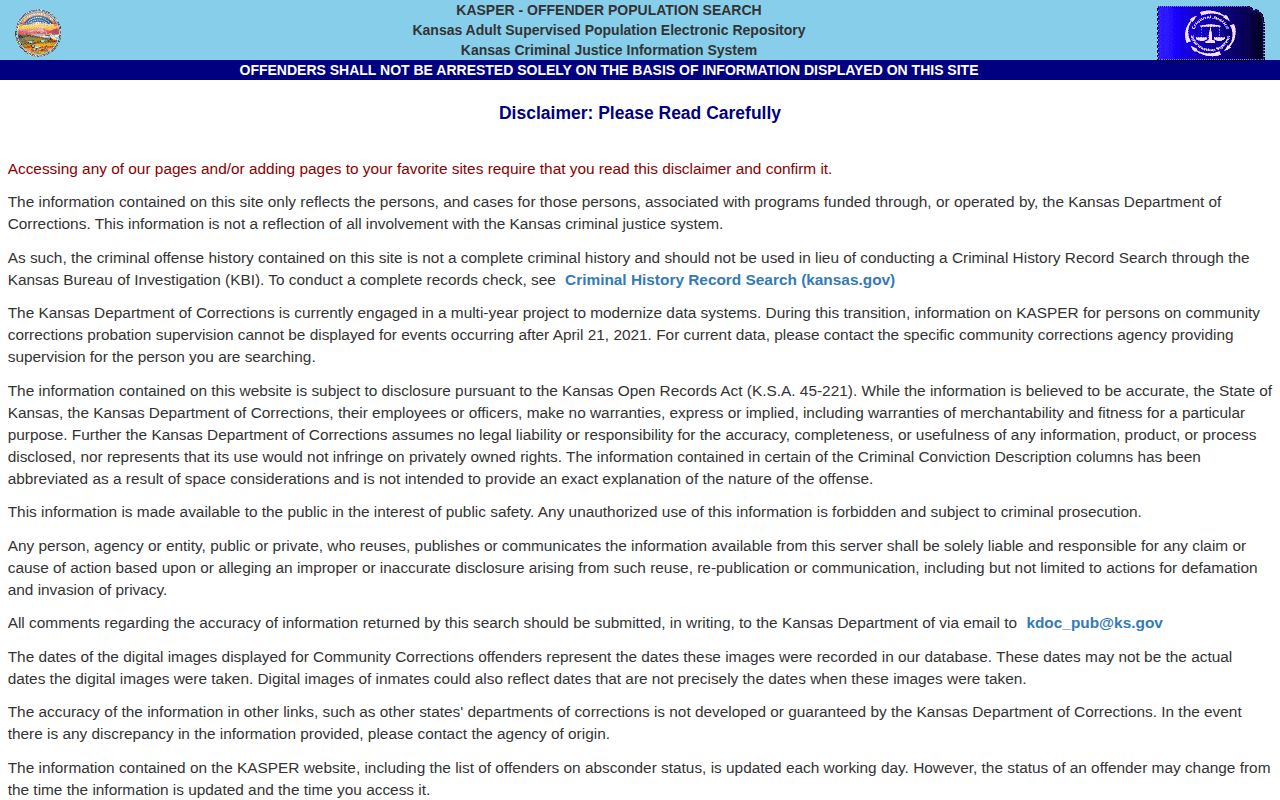
This form sits after the county jail checks for a reason. It answers a different custody question.
KASPER entries tend to persist. KDOC says a name stays in the system unless the conviction is overturned, expunged, or erased by executive clemency. Release dates can move as credits and forfeitures accumulate, so treat the date as an estimate and the location as a changing status. KASPER also leaves out most new county arrestees and anyone sent to Kansas under the interstate corrections compact. An empty result says little about a Douglas County booking.
Douglas County Booking Status
A booking can vanish from view while the underlying file still exists. Match the source to where the person's case actually stands rather than reading a missing roster row as an answer.
| Status | Best record | Photo path |
|---|---|---|
| Just booked or recently released | Booking Recap for 14 days | PIO request with CHRI number |
| Held now | In Custody | PIO request; roster has no photo |
| Released after recap expires | Targeted KORA request and court case | Ask PIO or records custodian |
| Sentenced to Kansas custody | KASPER | KASPER often has a KDOC photo |
| Federal or ICE custody | BOP or ICE locator | Neither locator promises a photo |
Kansas draws a line worth knowing. County jail sentences run 364 days or less. State and federal prisons are separate systems entirely. That split trips people up, so keep it straight. KASPER is not a substitute for the Douglas County roster. The county reports never search the state prison population.
Walking out of DCCF does not close the court matter. A person can bond out while the case moves ahead. Prosecutors may later decline, amend, or dismiss the charges. Booking Recap keeps showing the admission until its two-week window closes. From there, a focused records request and the court file are the durable path. An expunged matter deserves different handling than an entry that simply aged out.
Douglas County Busted Court Outcomes
A busted mugshot shows a moment. The court file tells you what happened next. When a case is online, the Kansas District Court Public Access Portal lists the case number, the parties, the lawyers, the judge, the status, and upcoming hearings. The county's six-month hearings calendar fills in scheduling gaps. It stops short of outcomes, though. Some filings sit only on a courthouse terminal, so a trip downtown can still pay off.
Confirm you have the right person and case number. Then read the docket and the final journal entry. These show the filed counts, any amendments, a dismissal or diversion, a plea or verdict, and the sentence. Ordinance cases from Lawrence, Eudora, and Baldwin City may stay in municipal court instead. A citation can exist without a jail booking. A booking can end without any charge ever being filed.
Smart Search filters district cases by type, status, filing date, and judicial officer. One caution applies. Online case information and the actual filed documents are not the same thing, because paper files depend on eCourt conversion and sealed or expunged matters stay out. If the file you need is missing, ask the clerk or use a public-access computer at the courthouse. The county's criminal-defendant guide adds a useful point. Defendants often appear several times, and a judge generally sets bond. An early hearing rarely settles the whole matter.
- Arraignment
- A court appearance where charges and a plea are addressed.
- Bond
- Terms set for release while a case is pending.
- Disposition
- The recorded outcome of a charge or case.
- Expungement
- A court-ordered restriction on eligible records.
The Douglas County hearings calendar illustrates the scheduling layer.
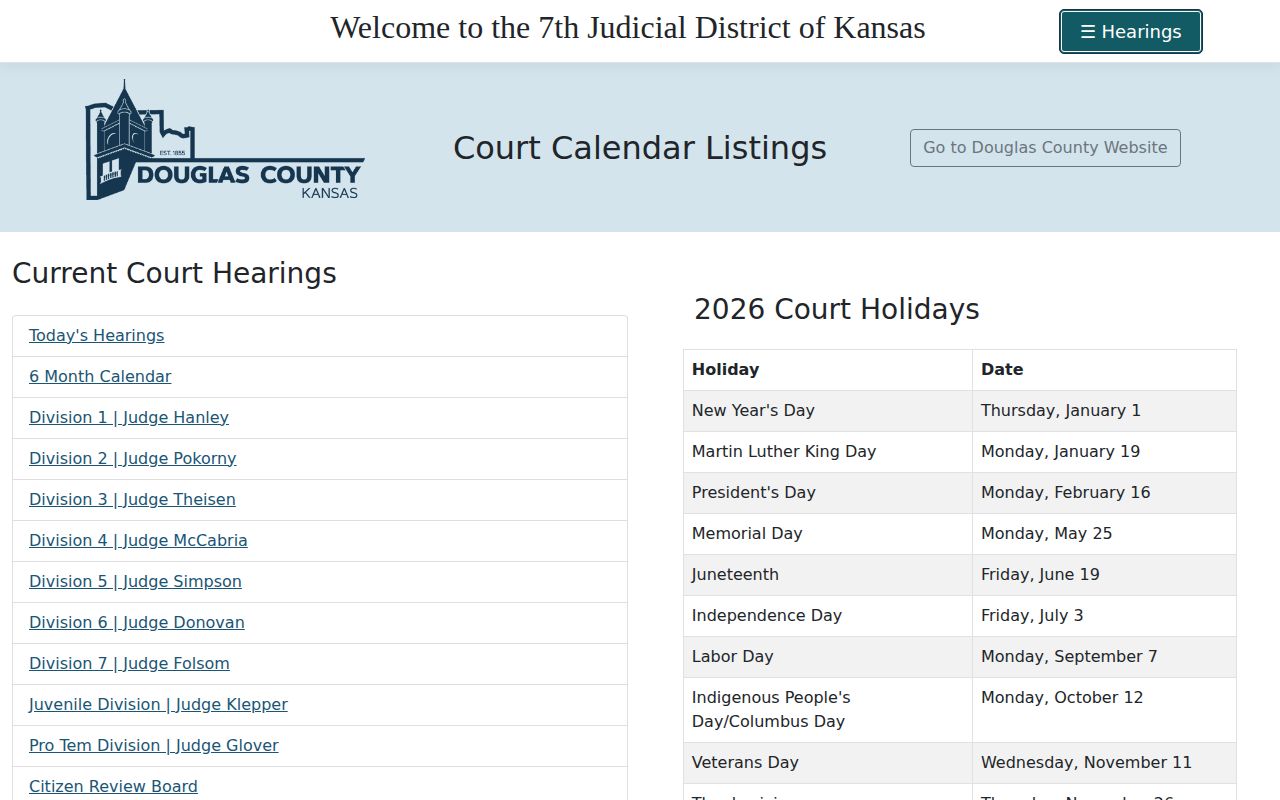
Find the hearing on the calendar first. Then pull the court case for the legal result.
When Douglas County Reports Fail
When the county's inmate reports go down, a fallback plan matters. Check the reports landing page for an outage notice. For current custody, call corrections at 785-830-1000. VINE handles status and alerts but no photos. Send the Public Information Office a precise request when you need the image, and file through NextRequest for a formal record.
A dead page changes nothing on the ground. The person is still in custody, and the booking still exists. Have the exact name, date range, arresting agency, and any case or CHRI number ready so staff can locate the right record fast.
One more trap: name collisions. Search results often blend Douglas County, Kansas with lookalike counties in Colorado, Georgia, Nebraska, and Oregon. Confirm Kansas in the agency name, the address, and the court before matching anyone. A similarly named sheriff page from another state can send you to the wrong warrant, jail, or photo.
Call published agency numbers, never contact details lifted from a social post or a caller. Corrections handles custody at 785-830-1000. The records custodian is 785-832-5211. Public Information, at 785-832-5113, handles images. These are separate jobs, and a narrow question aimed at the right unit beats a broad blast to every office.
Douglas County Booking Office Move
Addresses here have a history. The jail left the old Law Enforcement Center for East 25th Street in 1999. Sheriff operations moved next door in 2026 as part of the newer public-safety campus. That explains why an older DGSO form or a saved search result may still list 111 East 11th Street.
Pick an address by function, not just by agency name. Corrections and the Douglas County Correctional Facility sit at 3601 East 25th Street. Current sheriff operations are at 3605 East 25th Street. Keep the address printed on an older form when you describe that source, but rely on the live directory for today's contact.
Old Douglas County Busted Records
That 14-day recap is just an access window. It says nothing about destruction. Douglas County sheriff retention schedules keep different record classes for different periods, and some permanent government material may pass to the Kansas State Archives. Older law-enforcement files can still be closed for privacy, investigation, juvenile, expungement, or security reasons.
Start with the office that created the record, since it knows whether a file is active, transferred, destroyed under schedule, or closed by law. For historical government material, the Kansas State Archives government-records guidance is the right place. Give staff the agency, the person, an approximate date, and the record type. A narrow series and date beats asking an archive to run a broad name search.
Retention and access are two different decisions. A record can survive but stay closed, or an open record can hit its lawful destruction date. Sheriff schedules cover booking, custody, investigative, and administrative series, each with its own period. Archives staff can spot transferred holdings, but the sheriff remains the first stop for a modern DCCF booking photograph. National Archives and federal FOIA routes only fit records a federal agency created.
Douglas County Busted Mugshots by City
Each city keeps its own police records. The county jail centralizes publication once an arrest becomes a DCCF booking. Lawrence posts a calls-for-service log that adds incident context without being an arrest list. No comparable official blotter was verified for Eudora or Baldwin City.
- Lawrence Busted Mugshots: Lawrence Police reports and calls, followed by the DGSO booking path.
- Eudora Busted Mugshots: Eudora Police records requests and county booking reports.
- Baldwin City Busted Mugshots: Baldwin City Police news, clerk records, and DCCF booking checks.
The city agency can supply its incident report. DGSO controls the county booking report and photo request. The municipal or district court records the result, depending on the allegation filed.
Lawrence's calls log updates through the day, but it should never be relabeled as a list of people arrested. Eudora offers a city open-records form that can route a request to Police. Baldwin City's clerk page identifies the police chief as custodian of police business and links its request form. In all three cities, the city report explains the police event while DCCF records the county booking. Keeping those custodians separate avoids asking a municipal clerk for a sheriff-held mugshot.
Local news can add context but does not replace that chain. The Lawrence Journal-World public-safety section and Lawrence Times crime, fire, and courts section choose particular stories rather than publishing every county admission. DGSO press releases and social accounts also cover selected public-safety events without a fixed booking-photo schedule. An unofficial county archive may retain a face after the live report changes, yet its charge text can remain frozen. Verify identity with DGSO, current custody with In Custody, the admission with Booking Recap, and the legal outcome with the correct court. That sequence is the sound way to answer who was booked, where the person is now, and what the case finally became.
Get Douglas County Booking Records In Person
Armbrister leads the Douglas County Kansas Sheriff's Office
3605 E. 25th StreetLawrence, KS 66046
785-841-0007